Loan Servicing Software Pricing in 2026: What Lenders by Portfolio Size Are Actually Paying
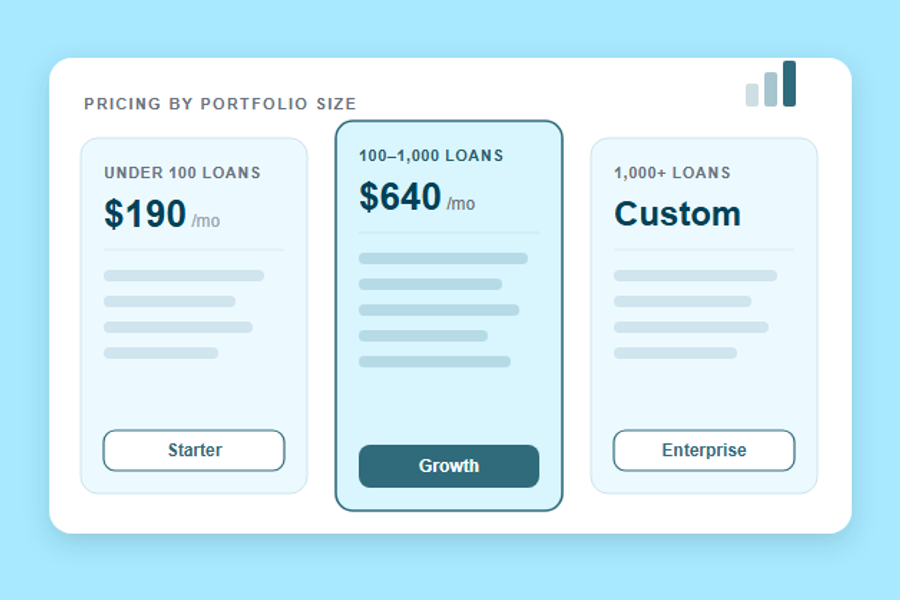
Table of Contents
Key Takeaways
- Three pricing structures govern what lenders pay for servicing software, and the one you sign onto determines whether your cost holds steady or triples as your portfolio grows.
- Lenders with fewer than 100 loans pay $89–$250/month on flat-fee platforms or significantly more at the same loan count on per-loan models.
- Most lenders hit both a pricing cliff and a capability gap between 100 and 200 loans, which is where mid-market servicing tools start to make financial sense.
- Implementation fees, per-user charges, and module add-ons routinely add 30–80% to the price listed on a vendor's website.
- The ROI break-even math flips in software's favour at roughly 50 to 75 active loans, when staff hours saved per month exceed the monthly subscription cost.
A loan servicing software pricing model is the structure a vendor uses to determine what you pay for managing post-origination loans. Loan servicing covers payment collection, interest calculation, reporting, and every operational function that follows disbursement. The platforms handling those functions rarely publish a price sheet. Most require a demo call before they share a number, which puts every lender at an informational disadvantage before the conversation starts.
I've worked with lenders across 13+ verticals for more than seven years, and the most consistent pattern I see is lenders discovering their actual software cost three to six months after signing. The base subscription looked fair. The implementation fee, per-user charges, module add-ons, and ACH pass-throughs were never in the comparison spreadsheet.
The pricing structure you sign onto determines what you pay today and what you'll pay the moment your loan portfolio grows.
This blog breaks down what lenders at each portfolio size are actually paying in 2026, what hidden costs to map before you sign, and the break-even math that tells you when the investment pays off.
Why Don't Two Lenders With the Same Software Pay the Same Price?
The same platform can cost three different amounts for three lenders at the same portfolio size, because pricing structures behave differently as loan count grows.
Loan servicing software vendors use three billing models: a flat monthly subscription, a per-loan volume tier, or a per-user charge. Each model scales differently, and most lenders evaluate platforms on base rate alone without checking which model applies.
Know Your Billing Model
On a flat subscription, your cost stays fixed whether you service 10 or 150 loans. Per-loan pricing ties your monthly bill directly to loan count, so a portfolio that doubles in size doubles the bill. Per-user pricing charges based on how many staff members access the system and creates a different cost cliff when the team grows.
The full list of loan management system features you need comes standard on some plans and costs extra on others. Understanding which capabilities are included vs. tiered is as important as the base rate.
Bryt uses a flat subscription model with no per-loan fees. Portfolio growth does not trigger an automatic increase in the monthly charge.
Track Your Tier Threshold
On per-loan or tiered plans, the loan count that moves you to the next price tier is the number that matters most. Most vendors build thresholds at 50, 100, 250, and 500 loans. Crossing one mid-contract typically resets your rate at the next billing cycle, not at renewal. Identify that number before you sign.
Bryt does not restructure pricing based on loan count. Lenders scale their portfolio without hitting cost escalation thresholds.
What Do Lenders with Fewer Than 100 Loans Actually Pay for Servicing Software in 2026
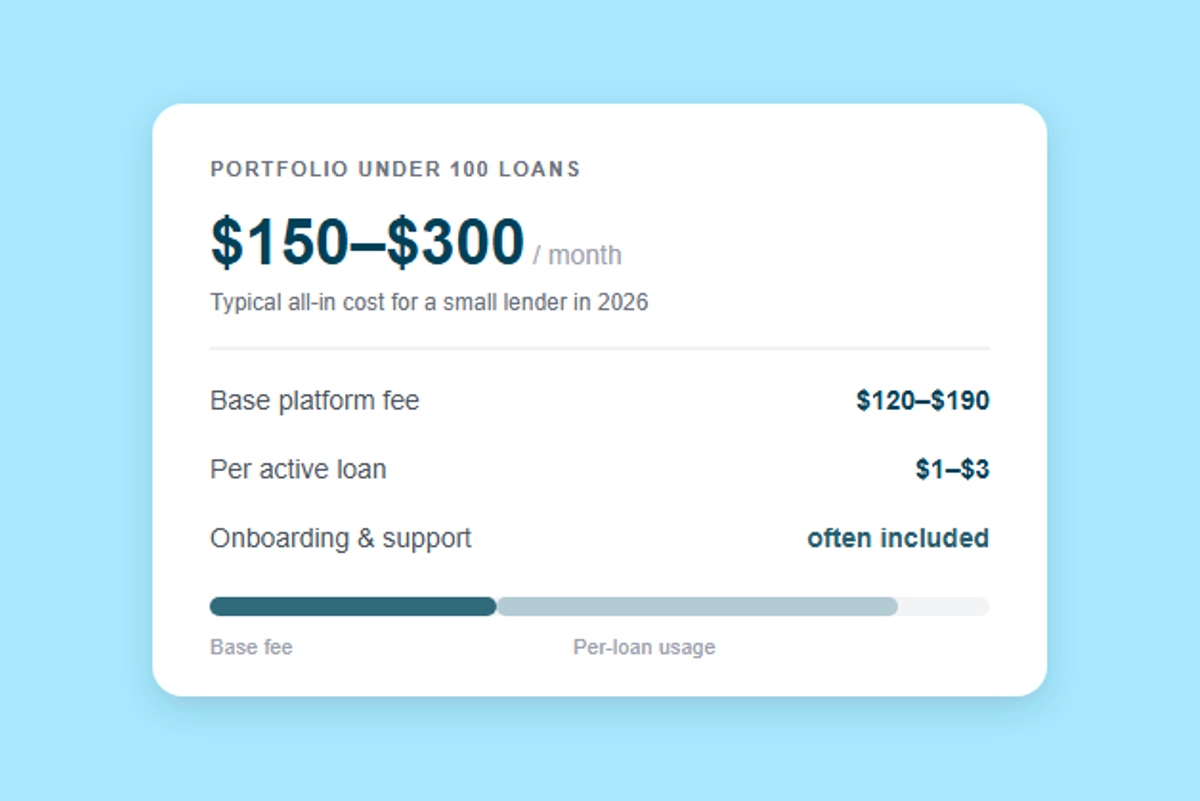
For a portfolio under 100 loans, flat-fee platforms typically run $89–$250/month; per-loan platforms at the same loan count run $100–$500/month depending on per-loan rate and selected modules. The spread at this portfolio size is wide, and most small-portfolio lenders either overbuy on enterprise features or underbuy on tools that break at 50 loans.
Match the Tool to Actual Loan Count
Small-portfolio lenders get burned in two ways. The first is paying for enterprise-tier features including investor portals, multi-branch reporting, and API access that won't serve a real operational need for 18 months.
The second is buying a cheap tool that handles basic payment tracking but can't produce an on-demand amortization schedule or a notice run without manual formatting.
The twelve questions in what private lenders must ask before choosing a loan management software are a practical checklist before any evaluation starts.
Bryt's base plan starts at $89/month with a 30-day free trial and no credit card required. No implementation fee applies.
Add Modules on Volume
The base subscription covers the core servicing workflow. ACH payment collection, borrower portal access, and custom user fields are add-on modules with separate pricing.
For a lender managing 50 loans at low transaction volume, the base plan covers most operational needs. Adding modules before the loan count supports the volume adds monthly cost without proportional operational return.
Bryt's ACH module cost includes ACHQ transaction fees with no additional monthly fee from Bryt for the module itself. Access scales with what you actually process.
When Does a Growing Portfolio Break Your Current Servicing Software's Pricing Model?
Most lenders hit both a pricing cliff and a capability gap between 100 and 200 loans, and the two problems arrive at the same time. At that point, the reporting limitations and manual workarounds in starter tools cost more in staff time than the subscription savings justify. Best loan servicing tools for mid-market lenders covers this transition in detail.
Spot the Capability Gap Before the Cost Cliff
Three operational gaps typically appear simultaneously at the 100-loan mark:
- Payment waterfall logic breaks on edge cases,
- Reporting requires manual export-and-reformat cycles, and
- Loan tracking across multiple loan types becomes inconsistent across periods. Each creates audit risk.
A lender running 150 loans on a tool designed for 50 is not saving money on software. They're paying their servicing team to patch the gaps. A loan modification request on a platform that doesn't handle it natively costs a servicer hours per event.
Bryt's Professional plan adds modular depth (ACH, borrower portal, reporting) without requiring a platform migration. Lenders stay on the same system through the growth stage.
Calculate the Mid-Market Cost Range
Mid-market servicing platforms on modular flat-fee structures typically run $300–$900/month for portfolios between 100 and 500 loans. Enterprise contract pricing in this range starts with custom quotes above $1,000/month.
Lenders who need modular loan servicing platforms to manage multiple loan types under one system reduce total cost of ownership more than any negotiation on base rate can achieve.
Bryt’s API module is available on Professional and Enterprise plans for lenders who need system integration at scale.
Lenders on the Business plan access core servicing without the API overhead until the volume supports it.
What Costs Are Never Listed On the Pricing Page
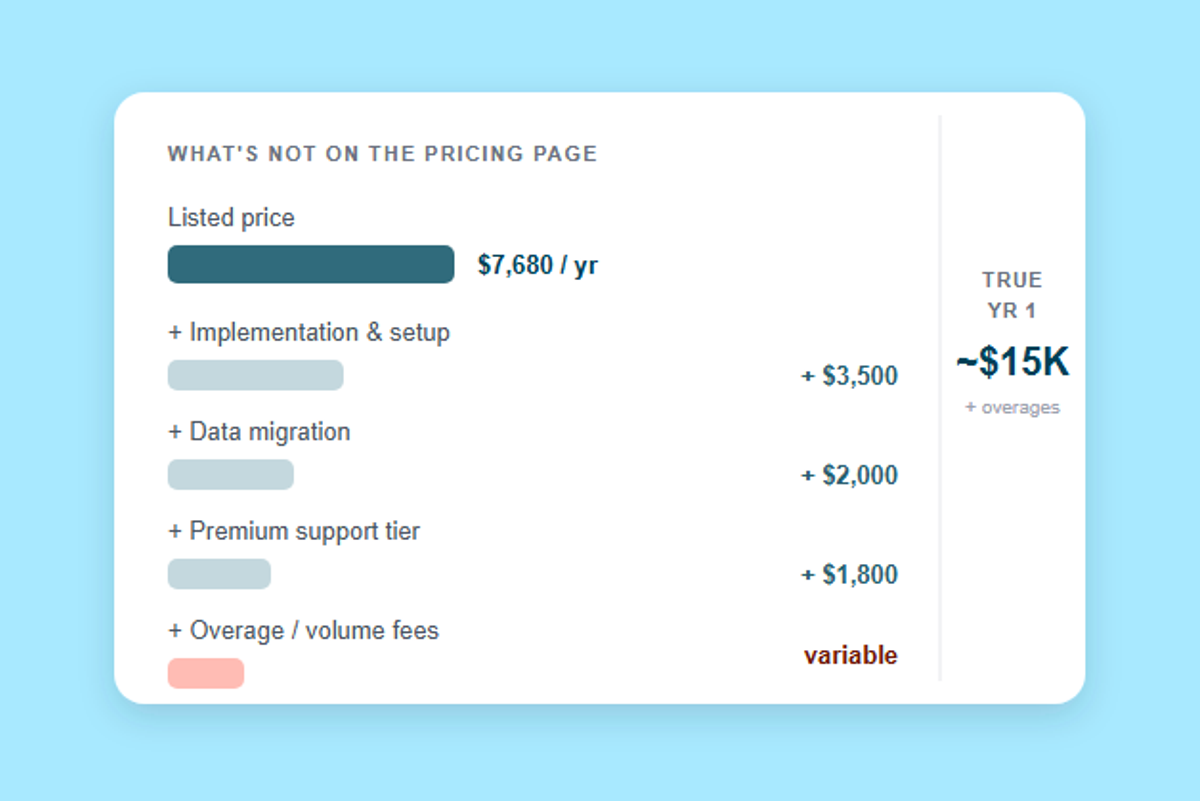
Four cost sources routinely add 30–80% to the listed subscription price and surface only after a lender signs. Mapping them in advance changes what belongs in your evaluation scorecard before any vendor conversation.
Check for Implementation Fees
Implementation fees cover data migration, configuration, and onboarding. On some platforms, this runs $2,000–$10,000 upfront as a one-time cost. Platforms with no implementation fee eliminate this.
If your current tool is showing loan management system upgrade red flags, add the migration implementation cost to your transition estimate, not just the monthly subscription delta.
Bryt charges no implementation fee. No onboarding cost ties to the plan, regardless of portfolio size.
Count Every Stacking Layer
Per-user fees, add-on modules, API access, and ACH transaction pass-throughs add each layer on top of the base subscription. A lender with five users, ACH enabled, and API access active can pay 2-3x the listed base rate.
Additional tenant accounts for lenders operating multiple separate lending entities carry a one-time $200 setup fee and $50/month per tenant, which are disclosed upfront and remain predictable across the contract.
In Bryt, all module add-on costs are disclosed before purchase. No hidden overages apply to loan volume or user activity within standard usage.
How to Calculate What Loan Servicing Software is Worth at Your Portfolio Size
The ROI break-even calculation is direct - compare the monthly software cost against the staff hours the software replaces, priced at your blended hourly rate.
At a $30/hour staff rate with 10 hours saved monthly, software pays for itself at $300/month. Most lenders cross that threshold well before they expect to.
Run the Hours-Saved Math First
Manual payment posting, loan tracking, notice generation, and period-end reporting are the four functions where servicing software replaces the most staff time. Estimate the monthly hour count for each before evaluating any platform.
If you can't estimate it, ask your servicing team what they spent the most time on last quarter. That answer typically points to the feature worth prioritizing in any comparison.
Worcester Financial reduced operational costs by 50% and saved 64 hours monthly after moving to Bryt. Envest Microfinance saved 40+ hours monthly. Both portfolios were under 200 loans at the time.
Apply the Formula Before the Contract
Monthly staff cost saved = hours saved × blended hourly rate. If that number exceeds the software's fully loaded monthly cost (base subscription plus modules plus transaction fees), the software earns its position. If it doesn't, you're either overbought on features or under-using the platform at your current loan count. The full ROI framework is in loan servicing software ROI.
Bryt's modular pricing lets lenders start with the base plan, confirm the hours-saved math from live usage in the 30-day trial, and add modules only when the operational volume supports the added cost.
The Bottom Line
Loan servicing software pricing is a structure that determines what you pay today and what you'll pay at 200 loans. The lenders who evaluate well start with the pricing model type, not the base rate. They map hidden costs before signing, and they run the break-even math against actual staff hours.
The loan servicing software market is growing at a 9.96% CAGR through 2034 according to IMARC Group, with Technavio forecasting 13.4% CAGR from 2024 to 2029, driven by lender demand for operational efficiency. That growth means more vendors, more pricing complexity, and more room to sign the wrong contract. Lenders who understand the pricing architecture now make better decisions at every portfolio size.
Bryt Software offers post-origination loan servicing starting at $89/month with no implementation fee, no per-loan fees, and a 30-day free trial.
If you're evaluating platforms or outgrowing your current tool, schedule a demo to see exactly what Bryt costs at your portfolio size and which modules your operations actually need.