Seasonal vs Monthly Equipment Loan Schedules: Why Delinquency Reports Break
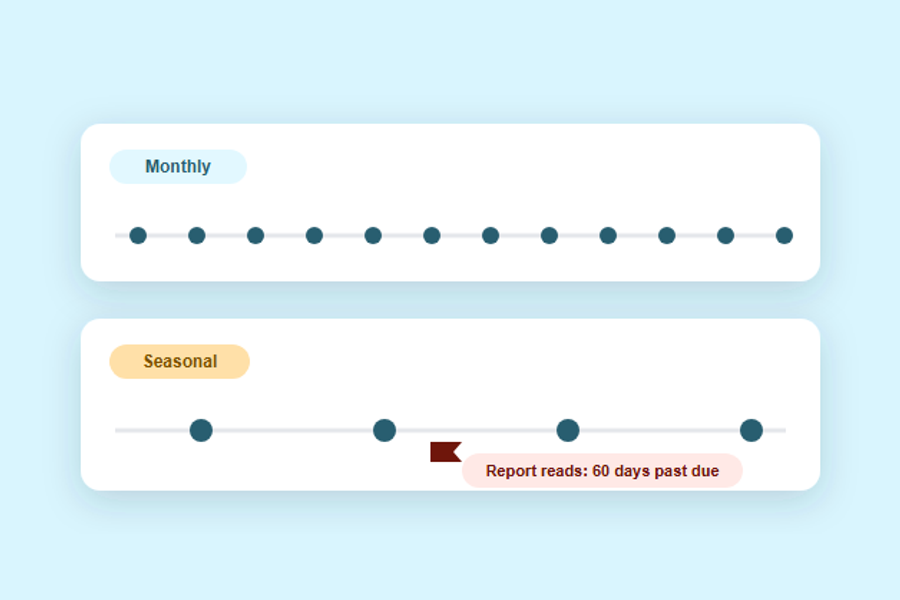
Table of Contents
Key Takeaways
- A quarterly-paying equipment borrower configured at monthly payment frequency generates two phantom due dates per quarter, filling the delinquency aging bucket with a borrower who has never missed a payment.
- Monthly payment frequency fires late fees against eight phantom due dates per year on a quarterly equipment loan, creating charges the borrower never contractually owed.
- Fixed-date semi-annual schedules misalign with harvest-cycle revenue timing and produce residual delinquency flags even after the frequency is corrected; $0-payment period configuration resolves the residual mismatch.
- Late notice triggers fire against phantom monthly due dates in every non-payment month, reaching current borrowers until the frequency configuration is corrected.
Seasonal equipment loan payment frequency is the configuration that places a borrower's contractual payment obligations at quarterly, semi-annual, or annual intervals.
Monthly payment frequency generates a contractual due date every 30 days. That structure is correct for a consumer installment loan that carries a payment obligation in every period of the term.
Applied to a seasonal equipment loan, monthly frequency creates due dates in months where the borrower contractually owes nothing. The system reads each as a missed payment.
This blog covers seasonal equipment borrowers - agricultural operations, construction equipment fleets, and seasonal businesses. Production-cycle manufacturing borrowers involve a different servicing mismatch documented in B2B manufacturing vs. commercial loan servicing.
The four errors below are specific to seasonal payment frequency misconfiguration. Each block below identifies one error, explains the delinquency mechanism, and documents the configuration correction.
Why Does a Quarterly-Paying Equipment Borrower Appear 60 Days Delinquent on a Loan That Has Never Missed a Payment?
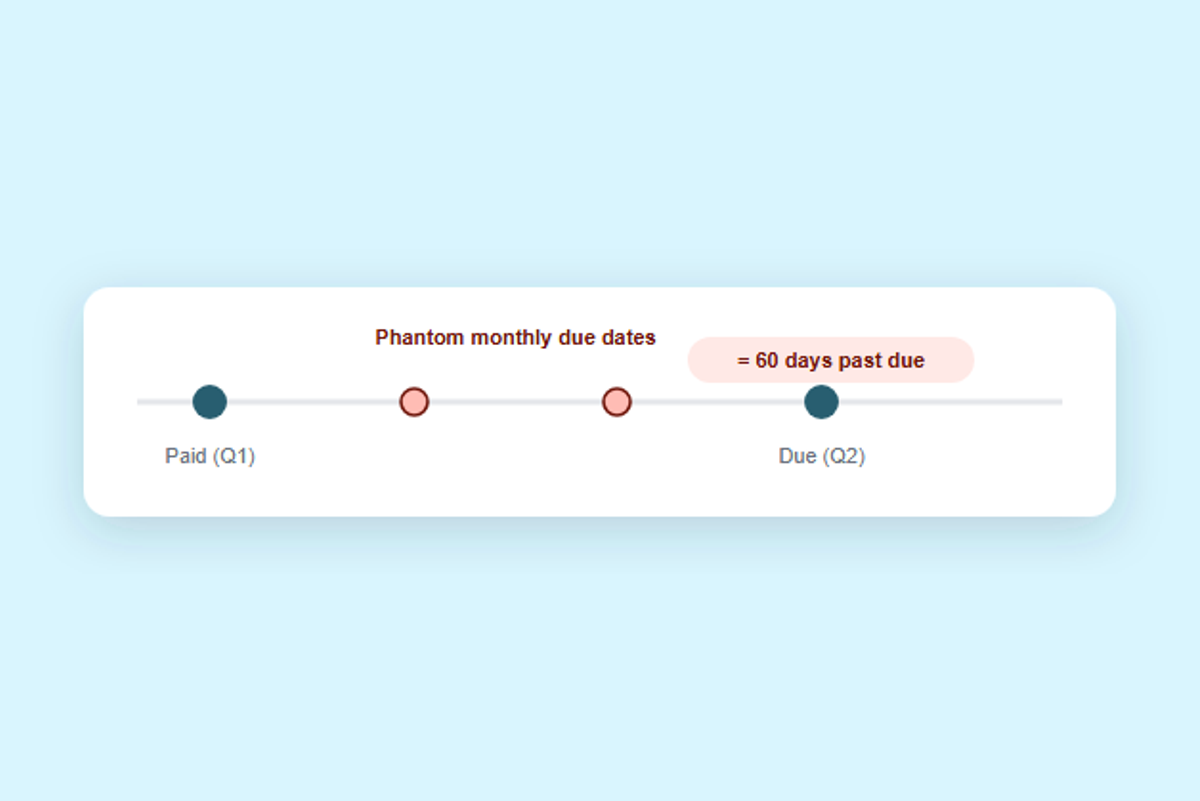
Monthly payment frequency applied to a quarterly-paying equipment borrower generates two phantom due dates per quarter, and the aging report records both as missed payments. The borrower has not violated their loan agreement. The system configuration has.
Identify the Default Frequency
Monthly frequency is the path of least resistance at loan setup. It is the default for most loan structures and requires no additional configuration thought. A quarterly-paying borrower configured at monthly frequency generates a contractual due date in months 1 and 2 of every quarter. No payment arrives. The delinquency aging clock runs. Both months register as missed.
In Bryt, the Payment Frequency field in the loan creation wizard offers Quarterly, Semi-Annual, and Annual as distinct selections. Setting the correct frequency at loan creation prevents phantom due dates from generating.
Read the Report Correctly
The Aging Report reads unrecorded payment activity. On a quarterly loan at monthly frequency, months 1 and 2 of each quarter carry no recorded payment - the report counts both as overdue.
The Balances Report reads $0 recorded payments instead of unrecorded activity, showing accurate portfolio health for loans with seasonal payment structures.
In Bryt, run the Balances Report for any seasonal equipment portfolio review. The Aging Report overstates delinquency on these loans until the frequency is corrected.
Set the Correct Frequency
Quarterly, Semi-Annual, or Annual payment frequency at loan creation eliminates phantom due dates. No phantom due date means no missed-payment event in the amortization schedule.
The frequency-mismatch error in consumer lending is documented in loan setup errors that corrupt consumer installment loans; the correction follows the same principle: configure frequency to match the borrower's contractual obligation, not the system default.
In Bryt, select Quarterly, Semi-Annual, or Annual in the Payment Frequency field at loan creation. Changing frequency after loan creation requires a loan modification through the Modify Loan workflow.
How Does Monthly Frequency Charge a Quarterly Equipment Borrower Late Fees?
The late fee trigger fires a set number of days after a scheduled due date passes without payment. Monthly frequency creates 12 due dates per year. A quarterly borrower has a contractual payment obligation on 4 of those dates. Late fees accrue on the other 8.
Trace the Late Fee Trigger
Monthly frequency on a quarterly loan generates a phantom due date in each non-payment month. The late fee trigger fires against each phantom event. The borrower's loan record accumulates late fee charges for months in which the loan agreement imposed no payment obligation.
The contrast with production-cycle manufacturing mismatches (covered in B2B manufacturing vs. commercial loan servicing) is that manufacturing timing errors misplace payment timing; here, the late fee trigger fires against due dates that have no legal basis in the loan at all.
In Bryt, the loan's activity history shows each late fee entry with its associated due date. Each phantom monthly due date appears as a separate late fee event.
Modify the Late Fee Setting
A correctly configured quarterly-frequency loan carries no due date in non-payment months. The late fee trigger has no event to fire on. On a misconfigured loan already carrying phantom late fees, a loan-level change stops further accrual immediately.
In Bryt, go to Modify Loan > Late Fees > select ‘No late Fees will be charged.’This stops late fee accrual at the individual loan level without affecting other loans in the portfolio.
Eliminate Phantom Due Dates
Correcting payment frequency at loan creation removes phantom due dates before they generate. No phantom due date means no event for the late fee trigger to fire on in non-payment months, across every quarter for the life of the loan.
In Bryt, setting Payment Frequency to Quarterly, Semi-Annual, or Annual at loan creation leaves no due date in non-payment months. The late fee trigger has no event to fire on.
Why Do Harvest-Cycle Equipment Loans Break Even After Switching to Semi-Annual Frequency?
A fixed-date semi-annual loan fires payment due dates on specific calendar dates regardless of when the harvest revenue arrives. When the contracted payment date precedes the harvest cash event, the borrower is flagged late again, even though the payment frequency is now correct.
Identify the Residual Mismatch
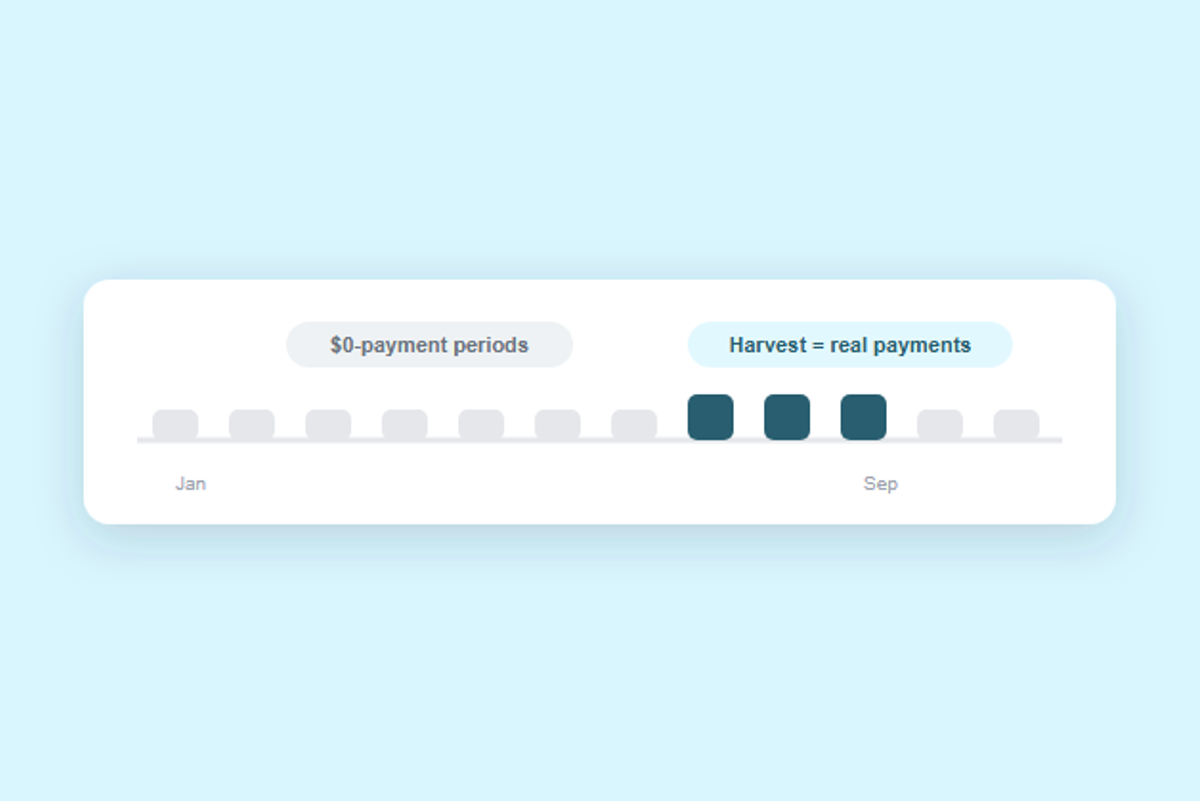
A fixed-date semi-annual loan fires on June 1 and December 1 every year. A harvest-cycle agricultural borrower receives revenue after the October fall harvest and after the April spring planting. The June due date precedes the harvest.
The borrower cannot pay. A delinquency event fires on a correctly configured frequency. Farm equipment financing is routinely structured with annual, semi-annual, or quarterly payments aligned to farmer cash flow (FCSAmerica Equipment Payment Calculator).
Agricultural lenders who service these loans through a generic system face this fixed-date vs. harvest-cycle mismatch as a structural problem (Wilary Winn: Secondary Market Agricultural Loan Servicing).
In Bryt, the loan's amortization schedule displays contracted due dates. Compare those dates against the borrower's revenue calendar before selecting a fixed semi-annual date.
Configure $0-Payment Periods
A $0-payment period resolves the residual mismatch. The loan carries no payment obligation in the non-harvest months. Accrued interest continues to accumulate on the outstanding principal balance. The loan status holds as Current. No delinquency event fires. This configuration requires a loan modification on the existing loan record.
In Bryt, go to Modify Loan > Payment/Amortization > edit the relevant pay period, set the Custom Payment to $0, then select ‘Apply these settings to future pay periods’ and click Save. Interest accrues; the loan remains current through the non-payment months.
Choose the Right Report
The Balances Report reads $0 recorded payments accurately for each configured non-payment period. The Aging Report reads unrecorded payment activity and shows distorted output for any period where a $0 payment was configured but not recorded as such.
In Bryt, run the Balances Report after configuring $0-payment periods to confirm the loan's outstanding balance and status reflect correctly before the next payment cycle opens.
What Happens to Late Notices When an Equipment Borrower Has Not Paid for Four Consecutive Months
On a correctly configured quarterly-frequency loan, no late notice fires in months 1 through 3 of the quarter because no due date exists in those months. On a monthly-frequency misconfigured loan, a late notice fires in each of the three non-payment months of every quarter.
Map the Notice Trigger
The late notice trigger fires a set number of days after a payment due date passes without a payment recorded. The trigger links to the due date event, not to elapsed time since the last payment received.
A quarterly borrower configured at monthly frequency has a phantom due date in each non-payment month. Each phantom due date fires a late notice. The borrower receives three late notices per quarter on a loan where no payment was ever missed.
In Bryt, the Notices dashboard shows all notices by status: sent, queued, and failed. Locate the late notice entries and trace each to its associated due date to identify which phantom due dates generated the trigger.
Verify Notice Output
After reconfiguring the payment frequency or applying $0-payment periods, confirm the Notices dashboard shows no late notice queued or sent for the corrected non-payment periods before the borrower receives any communication from the servicing system.
In Bryt, open the Notices dashboard after reconfiguring. Check the sent and queued columns to confirm no late notice was generated for any non-payment period in the corrected loan record.
The Bottom Line
Four frequency-mismatch errors: phantom due dates in the aging report, late fees on months the borrower owed nothing, harvest-cycle timing gaps that persist after switching to semi-annual frequency, and late notices sent to current borrowers. Each originates at loan setup. Each compounds across the portfolio for every month the misconfiguration remains uncorrected.
A capable loan management system gives you the payment frequency options and report types to handle seasonal equipment loan structures without distorting your delinquency picture. If your aging report is showing current borrowers as 60 or 90 days late, the first place to look is payment frequency configuration.
Bryt Software is a post-origination loan management and servicing platform built for lenders managing seasonal equipment loan portfolios.
If your delinquency reports do not reflect your actual borrower performance, schedule a demo with us.